Story
The Problem Wasn’t 3D. It Was Making a Good Game With It
3D didn’t arrive too early. It arrived before many developers really knew how to turn it into good game design.
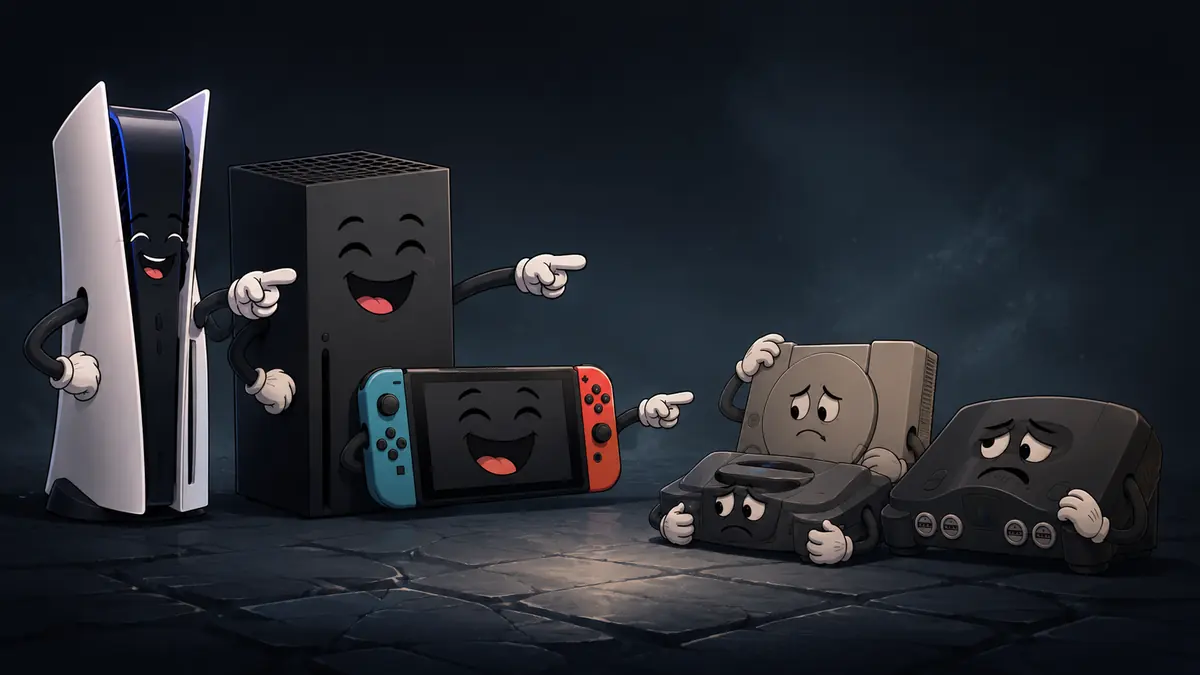
One of the arguments doing the rounds on social media right now is that 3D arrived too soon. In short: we should have had one more generation of 2D consoles.
That idea usually points to a certain roughness in early 3D games, not just visually, but in ways that had a real impact on gameplay too.
What do I think?
The point isn’t whether 3D arrived too early. The point is that 3D arrived before many developers really knew how, or what, to design around it.
First of all, I believe technological evolution has to run its course. If developers hadn’t experimented on PlayStation, Nintendo 64, and Saturn back then, we’d have been back at square one with PlayStation 2, GameCube, Xbox, and Dreamcast. You have to start somewhere, don’t you?
Besides, this isn’t exactly a new argument: David Jaffe was already talking about it a few years ago.
Where’s the truth? In the middle, as always. Let’s start from an assumption that maybe isn’t obvious to everyone: even though 3D was clearly the big selling point, the ace up everyone’s sleeve, for many studios it was not at all a given that this would be the future. Sega is the perfect example of that way of thinking. The Saturn itself was heavily influenced by the desire to keep a strong 2D identity. Sega had read the room correctly: there was no law saying everyone had to floor the accelerator on 3D.
But at the time, 3D gave you visibility. It made you more marketable. And not just 3D, but the whole technological angle: think about the naming of Nintendo 64 games, many of which had “64” in the title precisely to underline the tech factor. So yes, we could have had many more high-quality 2D games.
The fact that this didn’t happen, and that the platforms of the time objectively weren’t exactly “ready” for 3D, is also reflected in what happened with handhelds. Do you remember the Nintendo DS? A machine that, in some ways, was technologically close to the Nintendo 64. And what did we get as one of its launch games? Exactly: a 3D game, partly to show off the hardware, Super Mario 64 DS. At the time, people were already talking about a possible Ocarina of Time port as well. Then something happened: everyone realized that this kind of 3D wasn’t really ideal, and that maybe focusing on 2D games was the better route. And we got to enjoy a lot of little gems.
Still, the fact remains that 3D as we know it had to pass through those years of experimentation, otherwise we wouldn’t be where we are today. Once people realized there were other options, as happened on Nintendo DS, 2D came back into view.
We also shouldn’t generalize and say that every 3D game from that era was bad. Many people have compared the 3D of PlayStation, Saturn, and Nintendo 64 to the earliest 8-bit platforms, which produced 2D that was still pretty rough. But let me ask a question: was Pong, released in 1972, a bad game? Was it hard to read? Give Pong to a kid today and you’ll see they can play it without any problem, and probably have a great time with it too. Pong worked for one very specific reason: it ran on a limited platform and was built around that hardware. An almost symbiotic relationship: Pong’s hardware exists for Pong, and vice versa. It’s the same thing we would see much later with Super Mario 64, which, in my opinion, has aged far better than Sunshine. And we saw it with Zelda: Ocarina of Time too, a game that is still enjoyable today.
The second problem of that period was exactly this: developers said, okay, we have this hardware, we can add feature A, B, C, and D, do this, do that. The results weren’t always great. And so we got a lot of 3D games that were hard to parse and have aged terribly, certainly not like Pong from ’72. Even Majora’s Mask is a festival of extra features: as wonderful as it remains, as much of a masterpiece as it is, it is also very cumbersome, with imperfect controls, especially during transformations.
Want another example? Look at the first Star Fox: again, hardware built for the game, and a game built for the hardware, the Super FX chip. It’s one of Nintendo’s very first 3D games, and we’re talking about the SNES era here, not even the Nintendo 64. And yet it has aged beautifully: it’s still extremely playable today, almost with a gorgeous low-poly aesthetic. Then look at what happened with the sequel, Star Fox 2. They said: okay, we have a more powerful chip, we can add this, Arwing transformations, All-Range Mode, and so on. The result, at least for me, is that I’ve never managed to finish it, because objectively it’s a mess.
So the truth is that 3D couldn’t be stopped: it sold.
But things could have gone differently. However technically weak the machines were, it is always possible to create a design language that works. Pong did it in ’72, Star Fox did it in ’93, Zelda did it in ’98.
Plenty of others didn’t.